On this page, you will learn about food chains and webs and also different parts of the chain or food web. Below the text we have a simple food chain, the first part of the food chain is a producer. A producer is something which can make its own food, it doesn't need to feed of another organism. In this case our producer is grass as it uses photosynthesis to make its food. However sometimes the sun comes first in the food chain first as it is the source of energy which provides the producer with the energy to make its own food. The second organism in the chain is the primary consumer. This organism is the first to feed of another organism, in this example its is the grasshoper. Primary consumers are normally herboviroes however they could also be ominovers as well. The secondary consumer is normally a carnivore, in this case it's the shrew as its prey is the grass hopper. The tertiary consumer is again normally carnivore and this eats the secondary consumer, in our case it is an owl.
The complicated feature is the direction of the arrows, notice they all pointing fowards, this doesn't show that grass eats the grass hopper but rather that the grass is eaten by the grass hopper. Make sure you don't the direction of the arrows wrong, as it is common mistake made by students of all ages.

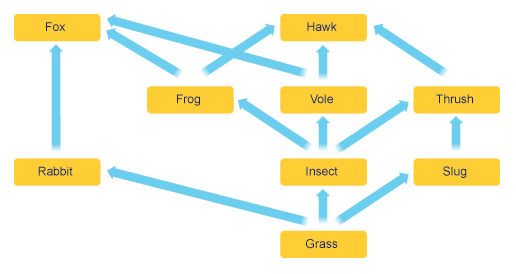
When all of the food chains in one habitat are joined up together, it forms a food web.Although it looks complex, it is just several food chains joined together. Here are some of the food chains in this food web: grass → insect → vole → hawk, grass → insect → frog → fox and finally grass → insect → vole → fox.
Notice that the frogs, voles and insects have more than one predator, but the rabbits and slugs have just one predator. This leads to some interesting effects if the population of one of the organisms in the food web decreases. Some animals can just eat more of another organism if food is in short supply, while others may starve to death. This in turn can affect the populations of other organisms in the food web as in as sense they all depend on each other to stay alive.
Lets add a senario, for example; What would happen if the population of insects decreased?There would be more food for the rabbits and slugs, so their populations would increase and thrive. However, there would be less food for the frogs and voles, so their populations would decrease and slowly die out. This means less food for the foxes and hawks but there are likely to be more rabbits and thrushes for them to eat, so their populations are likely to stay the same.